


- University
- Academic
- Schools/Vocational Schools
- Vocational School of Justice
- Vocational School
- Vocational School
- Department of Banking and Insurance (Turkish)
- Department of Computer Programming (Turkish)
- Department of Foreign Trade (Turkish)
- Department of Graphic Design (Turkish)
- Department of Interior Design (Turkish)
- Department of Construction Technology (Turkish)
- Department of Occupational Health and Safety (Turkish)
- Department of Media and Communication (Turkish)
- Department of Architectural Restoration (Turkish)
- Department of Radio and Tv Programming (Turkish)
- Department of Civil Aviation Cabin Services (Turkish)
- Department of Civil Aviation Transportation Management (Turkish)
- Department of Tourism and Hotel Management (Turkish)
- Department of Applied English Translation
- Vocational School Of Health Services
- Vocational School Of Health Services
- Department of Child Development (Turkish)
- Department of Physiotherapy (Turkish)
- Department of Paramedic (Turkish)
- Department of Opticianry (Turkish)
- Department of Medical Documentation and Secreteriat (Turkish)
- Department of Medical Imaging Techniques (Turkish)
- Department of Medical Laboratory Techniques (Turkish)
- Department of Elderly Care (Turkish)
- School of Applied Management Sciences
- School of Foreign Languages
- Faculties
- Faculty of Arts and Sciences
- Faculty of Fine Arts and Design
- Faculty of Law
- Faculty of Communication
- Faculty of Business
- Faculty of Engineering
- Faculty of Engineering
- Department of Computer Engineering
- Department of Biomedical Engineering
- Department of Electrical and Electronics Engineering
- Department of Industrial Engineering
- Department of Food Engineering
- Department of Genetics and Bioengineering
- Department of Aerospace Engineering
- Department of Civil Engineering
- Department of Mechanical Engineering
- Department of Mechatronics Engineering
- Department of Software Engineering
- Faculty of Health Sciences
- Medicine
- Graduate School
- Common Courses
- Schools/Vocational Schools
- Research
- Research Centers
- Library
- Smart Campus
- Technology Transfer Office
- İzmir Sciencepark
- Continuous Education Center (EKOSEM)
- Children's University
- Ethics Committee
- Teaching and Learning Center (EKOEĞİTİM)
- Psychology Application and Research Center
- Researcher Training Coordinatorship
- Research Collaborations And Innovation Coordinatorship
- Campus
- INTERNATIONAL
- Contact
FACULTY OF FINE ARTS AND DESIGN
Department of ArchitectureProf. Thomas Mical, PhD. was our guest
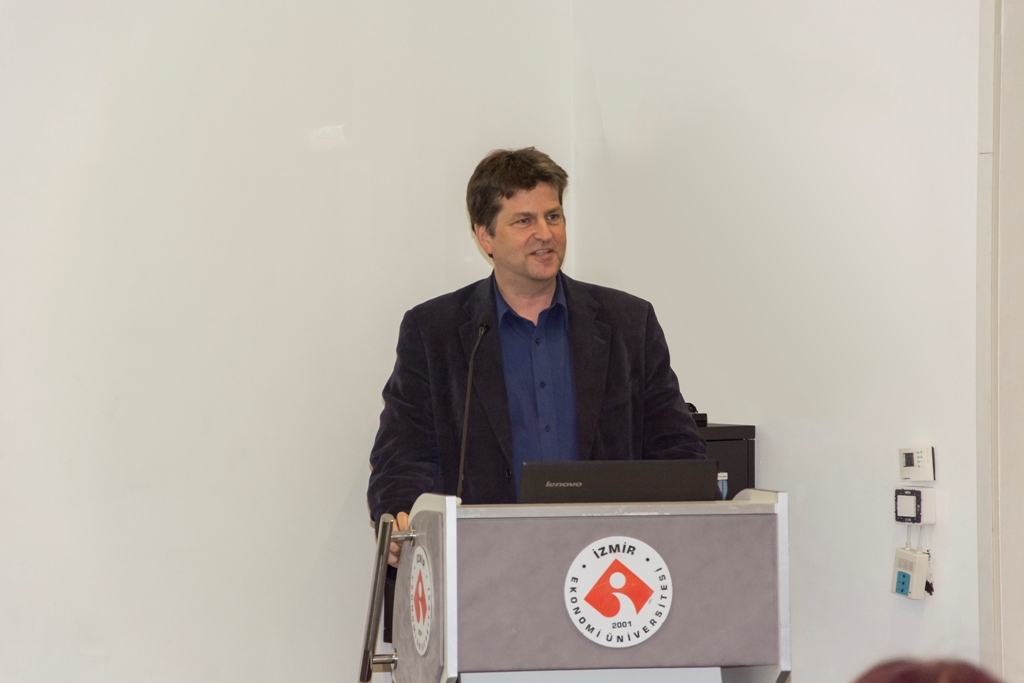
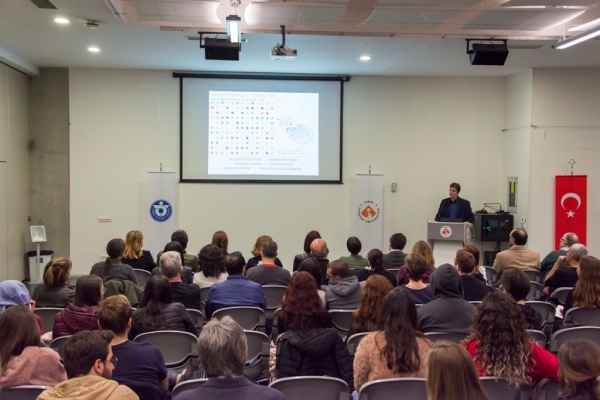
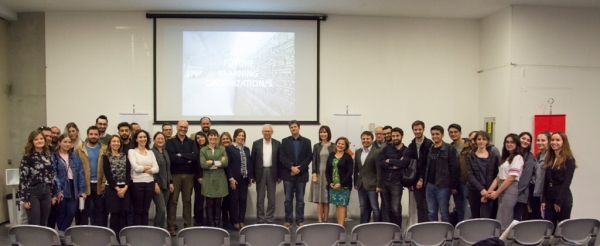
Thomas Mical, Professor of Architectural Theory at Auckland University of Technology, New Zealand, and international professor at the School of Design at the Shangai Institute of Visual Arts, gave a talk entitled “Design Thinking and Global Intelligence” as the guest of Department of Architecture of Faculty of Fine Arts and Design in İzmir University of Economics.
Thomas Mical has been teaching and researching globally on modern and hypermodern architecture and urbanism over a long career in diverse international architecture programs. He has an M.Arch. from Harvard GSD on sci-fi urbanism and a Ph.D. from Georgia Tech in architectural theory (with minors in philosophy and art history). He has taught 50 design studios globally and has been a tenured professor at Carleton University, Rensselaer Polytechnic Institute, University of South Australia, and Auckland University of Technology. He has held fellowships at the Architectural Association (UK), London School of Economics (UK), and DAAD and Fulbright (Germany). He was in the NEH Summer Institute on modernity in Delhi in 2011. His recent appoint include Visiting Professor at the Technical University of Vienna (2016), Tongji University CAUP (2017-2018), Shanghai Institute of Visual Arts (2018-2020) and Université libre de Bruxelles (2018-2020).
His teaching in architectural theory examines how concepts are formed, transformed, and mutate into architecture and wider cultural fields. He has taught internationally across a range of design disciplines - including architecture and urban design studios, masters and doctoral design thesis research methods, modern history-theory, design thinking, and a range of courses in media studies and culture studies to support innovative design pedagogy.
The research in architectural theory engages with the intrinsic and extrinsic drivers of emergent modes of spaces, mechanical and cognitive, and is increasingly focused on how sense and meaning are situated spatially, since modernity. The research methodologies involve qualitative analysis of new forms of subjectivity, emergence, and differentiation in the pervasive spatial mechanics of hypermodernity. He has published a book Surrealism and Architecture (Routledge, 2005) and is working on a few new books including “What Comes After Transparency?” this year.





















NEWSALL NEWS


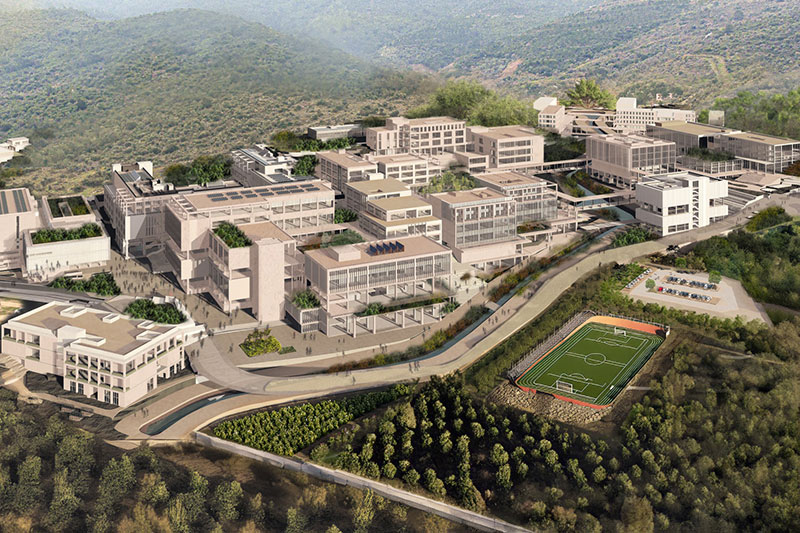
IZMIR UNIVERSITY OF ECONOMICS GÜZELBAHÇE CAMPUS
DetailsGLOBAL CAREER
As Izmir University of Economics transforms into a world-class university, it also raises successful young people with global competence.
More..CONTRIBUTION TO SCIENCE
Izmir University of Economics produces qualified knowledge and competent technologies.
More..VALUING PEOPLE
Izmir University of Economics sees producing social benefit as its reason for existence.
More..
You are one step ahead with your graduate education at Izmir University of Economics.