

- University
- Academic
- Schools/Vocational Schools
- Vocational School of Justice
- Vocational School
- Vocational School
- Department of Banking and Insurance (Turkish)
- Department of Computer Programming (Turkish)
- Department of Foreign Trade (Turkish)
- Department of Graphic Design (Turkish)
- Department of Interior Design (Turkish)
- Department of Construction Technology (Turkish)
- Department of Occupational Health and Safety (Turkish)
- Department of Media and Communication (Turkish)
- Department of Architectural Restoration (Turkish)
- Department of Radio and Tv Programming (Turkish)
- Department of Civil Aviation Cabin Services (Turkish)
- Department of Civil Aviation Transportation Management (Turkish)
- Department of Tourism and Hotel Management (Turkish)
- Department of Applied English Translation
- Vocational School Of Health Services
- Vocational School Of Health Services
- Department of Child Development (Turkish)
- Department of Physiotherapy (Turkish)
- Department of Paramedic (Turkish)
- Department of Opticianry (Turkish)
- Department of Medical Documentation and Secreteriat (Turkish)
- Department of Medical Imaging Techniques (Turkish)
- Department of Medical Laboratory Techniques (Turkish)
- Department of Elderly Care (Turkish)
- School of Applied Management Sciences
- School of Foreign Languages
- Faculties
- Faculty of Arts and Sciences
- Faculty of Fine Arts and Design
- Faculty of Law
- Faculty of Communication
- Faculty of Business
- Faculty of Engineering
- Faculty of Engineering
- Department of Computer Engineering
- Department of Biomedical Engineering
- Department of Electrical and Electronics Engineering
- Department of Industrial Engineering
- Department of Food Engineering
- Department of Genetics and Bioengineering
- Department of Aerospace Engineering
- Department of Civil Engineering
- Department of Mechanical Engineering
- Department of Mechatronics Engineering
- Department of Software Engineering
- Faculty of Health Sciences
- Medicine
- Graduate School
- Common Courses
- Schools/Vocational Schools
- Research
- Research Centers
- Library
- Smart Campus
- Technology Transfer Office
- İzmir Sciencepark
- Continuous Education Center (EKOSEM)
- Children's University
- Ethics Committee
- Teaching and Learning Center (EKOEĞİTİM)
- Psychology Application and Research Center
- Researcher Training Coordinatorship
- Research Collaborations And Innovation Coordinatorship
- Campus
- INTERNATIONAL
- Contact
- 25TH YEAR
FACULTY OF FINE ARTS AND DESIGN
Department of ArchitectureARCH 334 | Course Introduction and Application Information
| Course Name |
Looking, Thinking, Sketching
|
|
Code
|
Semester
|
Theory
(hour/week) |
Application/Lab
(hour/week) |
Local Credits
|
ECTS
|
|
ARCH 334
|
Fall/Spring
|
1
|
4
|
3
|
4
|
| Prerequisites |
None
|
|||||
| Course Language |
English
|
|||||
| Course Type |
Elective
|
|||||
| Course Level |
First Cycle
|
|||||
| Mode of Delivery | face to face | |||||
| Teaching Methods and Techniques of the Course | DiscussionCritical feedbackApplication: Experiment / Laboratory / WorkshopLecture / Presentation | |||||
| National Occupation Classification | - | |||||
| Course Coordinator | ||||||
| Course Lecturer(s) | ||||||
| Assistant(s) | - | |||||
| Course Objectives | In this Studio/Workshop the student will learn to use different techniques of visual communication by exploring them in a more experiential approach. Invention and Imagination will be encouraged in the process of designing the drawings/documents. This will help the student to understand the importance of conventional parameters of architecture such as form, space, proportion, texture, light and shadow, but also particular spatial experiences and events, people, sounds, smells, colors, materiality, and the role of invention and imagination. |
| Learning Outcomes |
The students who succeeded in this course;
|
| Course Description | In the Process of Making and Designing, all drawings and sketches, collages and words, photographs and models become documents of exploration and experimentation, as well as documents of representation. Like printmaking that places a layer over layer transcribing and transforming elements of the work of art, every sketch will play an important role in the thinking process to formulate a design idea. In using sketching as a critical thinking tool all documents created in class will help understand the objects we see such as sites, buildings, and landscape; transforming and creating a metaphorical structure that serves as a vocabulary used in the development of new ideas |
| Related Sustainable Development Goals |
|
|
|
Core Courses | |
| Major Area Courses |
X
|
|
| Supportive Courses | ||
| Media and Management Skills Courses | ||
| Transferable Skill Courses |
WEEKLY SUBJECTS AND RELATED PREPARATION STUDIES
| Week | Subjects | Related Preparation |
| 1 | Course introduction: syllabus overview & general discussion | |
| 2 | Line “Meanings of Line”:Discussion, reference books, line exercises | - Homework#1 |
| 3 | Line “Hand & Body”: Bodily drawing experiences with dif. scales | - Homework#2 |
| 4 | Line Quiz: Book review, grid study | Book: Why Architects Still Draw - (2014) Paolo Belardi |
| 5 | Figure “Abstraction”: Introduction to different materials | - Homework#3 |
| 6 | Figure “Composition”: Figure-ground study: proportion, balance | - Homework#4 |
| 7 | Figure Quiz:Book review, pixel study | Book: Ways of Seeing - (1972) John Berger |
| 8 | Mid-term Week | |
| 9 | Surface “Collage Technique”: Visual experiences | - Homework#5 |
| 10 | Surface “Material Challenge”: Material experiences | - Homework#6 |
| 11 | Surface Quiz:Book review, narrative study | Book: Reverse Perspective - (2002) Pavel Florenski |
| 12 | Drawing Project Project Design: Introduction of the pr., planning the process, initial sketches | - Homework#7 |
| 13 | Drawing Project Project Development: Individual critiques, construction process | - Homework#8 |
| 14 | Drawing Project Presentation Design: Individual critiques, animation, documentation | |
| 15 | Presentation | |
| 16 | Final Submission |
| Course Notes/Textbooks | Experiential Drawing, Robert Regis Dvorak. Crisp Publications, Inc. Menlo Park, California. ISBN: 9781560520658 Drawing on the Right Side of the Brain, Elizabeth Edwards. ISBN: 9780874775235 |
| Suggested Readings/Materials | Design Drawing, Francis D. K. Ching ISBN: 9781118061589 Drawing: A Creative Process, Francis D. K. Ching ISBN: 9780471289685 |
EVALUATION SYSTEM
| Semester Activities | Number | Weigthing |
| Participation |
1
|
10
|
| Laboratory / Application | ||
| Field Work | ||
| Quizzes / Studio Critiques |
3
|
30
|
| Portfolio | ||
| Homework / Assignments |
1
|
30
|
| Presentation / Jury | ||
| Project |
1
|
30
|
| Seminar / Workshop | ||
| Oral Exams | ||
| Midterm | ||
| Final Exam | ||
| Total |
| Weighting of Semester Activities on the Final Grade |
5
|
70
|
| Weighting of End-of-Semester Activities on the Final Grade |
1
|
30
|
| Total |
ECTS / WORKLOAD TABLE
| Semester Activities | Number | Duration (Hours) | Workload |
|---|---|---|---|
| Theoretical Course Hours (Including exam week: 16 x total hours) |
16
|
1
|
16
|
| Laboratory / Application Hours |
16
|
4
|
64
|
| Study Hours Out of Class |
10
|
1
|
10
|
| Field Work |
0
|
||
| Quizzes / Studio Critiques |
3
|
2
|
6
|
| Portfolio |
0
|
||
| Homework / Assignments |
1
|
8
|
8
|
| Presentation / Jury |
0
|
||
| Project |
1
|
6
|
6
|
| Seminar / Workshop |
0
|
||
| Oral Exam |
0
|
||
| Midterms |
0
|
||
| Final Exam |
0
|
||
| Total |
110
|
COURSE LEARNING OUTCOMES AND PROGRAM QUALIFICATIONS RELATIONSHIP
|
#
|
Program Competencies/Outcomes |
* Contribution Level
|
|||||
|
1
|
2
|
3
|
4
|
5
|
|||
| 1 |
To be able to offer a professional level of architectural services. |
-
|
-
|
-
|
-
|
-
|
|
| 2 |
To be able to take on responsibility as an individual and as a team member to solve complex problems in the practice of design and construction. |
-
|
-
|
-
|
-
|
-
|
|
| 3 |
To be able to understand methods to collaborate and coordinate with other disciplines in providing project delivery services.
|
-
|
-
|
-
|
-
|
-
|
|
| 4 |
To be able to understand, interpret, and evaluate methods, concepts, and theories in architecture emerging from both research and practice. |
-
|
-
|
X
|
-
|
-
|
|
| 5 |
To be able to develop environmentally and socially responsible architectural strategies at multiple scales. |
-
|
-
|
-
|
-
|
-
|
|
| 6 |
To be able to develop a critical understanding of historical traditions, global culture and diversity in the production of the built environment. |
-
|
-
|
X
|
-
|
-
|
|
| 7 |
To be able to apply theoretical and technical knowledge in construction materials, products, components, and assemblies based on their performance within building systems. |
-
|
-
|
-
|
-
|
-
|
|
| 8 |
To be able to present architectural ideas and proposals in visual, written, and oral form through using contemporary computer-based information and communication technologies and media. |
-
|
-
|
-
|
X
|
-
|
|
| 9 |
To be able to demonstrate a critical evaluation of acquired knowledge and skills to diagnose individual educational needs and direct self-education skills for developing solutions to architectural problems and design execution. |
-
|
-
|
-
|
X
|
-
|
|
| 10 |
To be able to take the initiative for continuous knowledge update and education as well as demonstrate a lifelong learning approach in the field of Architecture. |
-
|
-
|
-
|
X
|
-
|
|
| 11 |
To be able to collect data in the areas of Architecture and communicate with colleagues in a foreign language ("European Language Portfolio Global Scale", Level B1) |
-
|
-
|
-
|
-
|
-
|
|
| 12 |
To be able to speak a second foreign language at a medium level of fluency efficiently. |
-
|
-
|
-
|
-
|
-
|
|
| 13 |
To be able to relate the knowledge accumulated throughout the human history to their field of expertise. |
-
|
-
|
-
|
-
|
-
|
|
*1 Lowest, 2 Low, 3 Average, 4 High, 5 Highest





















NEWSALL NEWS


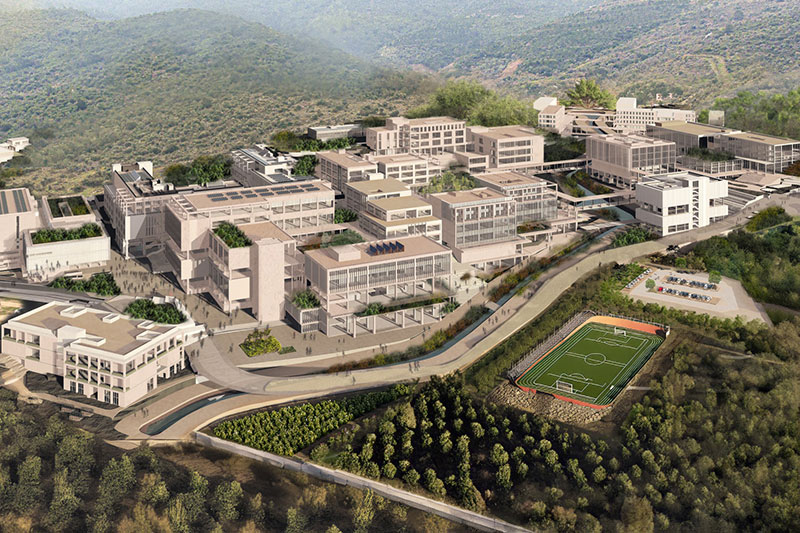
IZMIR UNIVERSITY OF ECONOMICS GÜZELBAHÇE CAMPUS
DetailsGLOBAL CAREER
As Izmir University of Economics transforms into a world-class university, it also raises successful young people with global competence.
More..CONTRIBUTION TO SCIENCE
Izmir University of Economics produces qualified knowledge and competent technologies.
More..VALUING PEOPLE
Izmir University of Economics sees producing social benefit as its reason for existence.
More..
You are one step ahead with your graduate education at Izmir University of Economics.